
The Evolution from an Image Archive to a Strategic DAM System

Your colleague asks for the latest campaign images or the current version of the logo. You know they’re stored somewhere, but is it on the local server, in a shared cloud folder, or in an old email attachment? Many organizations still rely on shared storage or a simple “ Image bank,” which inevitably leads to scattered files and a lack of control. In this article, I’ll take you through the evolution from the traditional image archive to today’s Digital Asset Management (DAM) system. I’ll show you why a DAM not only brings structure to the daily chaos of marketing but also forms the absolute foundation for future innovations.
The evolution: from folder structure to Image bank
In the past, an image archive was literally a physical cabinet full of slides and prints. With digitization, this archive moved to the local server at the office. Folders were created, but sharing them externally simply wasn’t possible back then. I remember this well from my own experience, when I worked at premedia organizations in the late 1990s. The internet was still so slow that media had to be distributed on CD-ROMs and later on DVDs. The result? Copies lying around everywhere and a massive fragmentation of your digital assets.
And even as technology advanced and we were able to easily share internal servers or early cloud folders, confusing folder structures riddled with duplicates continued to fuel the content chaos.
To address this, many companies introduced the Image bank. This was a huge step forward: an online environment where employees could visually search for photos and (sometimes) videos. However, a traditional Image bank remained primarily a passive repository. It worked well if you knew what you were looking for, but offered little intelligence or control over how files were actually used.
The Transition to a Full-Fledged DAM System
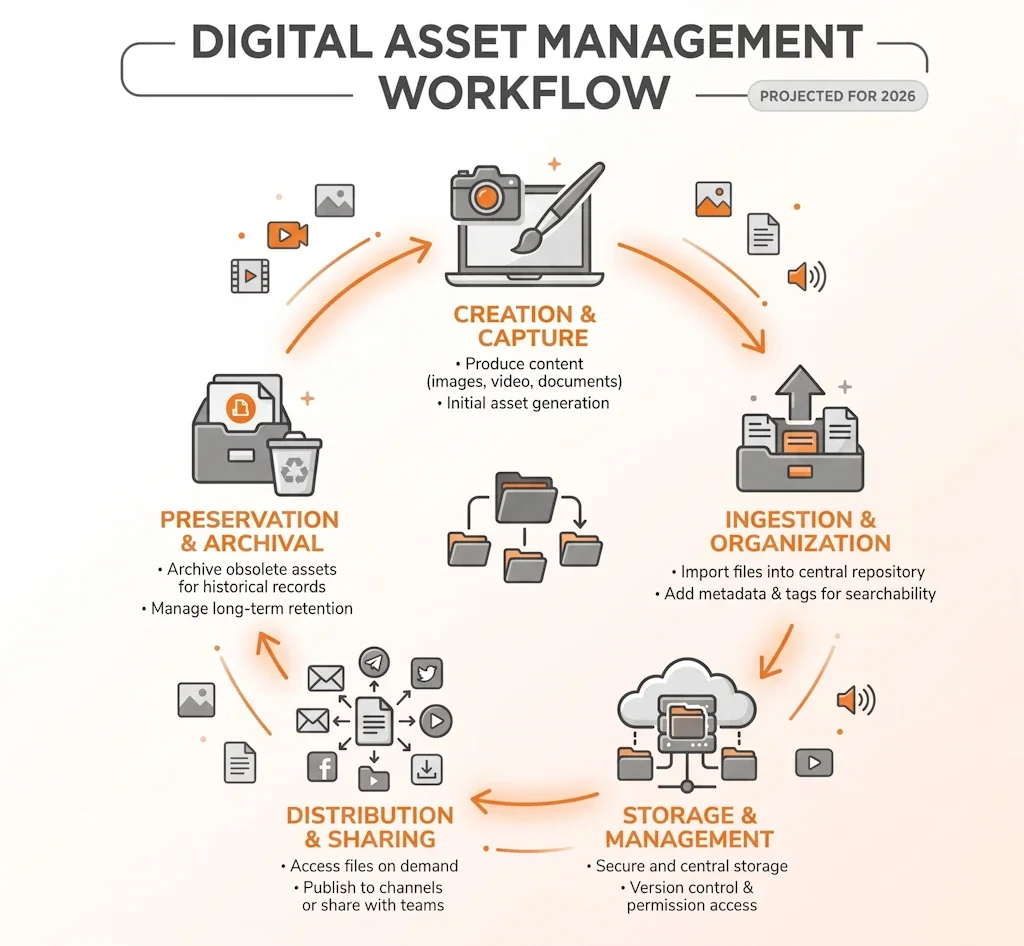
These days, we almost exclusively refer to a Digital Asset Management (DAM) system. While a Image bank is limited to the visual display of primarily images, a DAM goes beyond that with active workflows, multimedia files, smart metadata, comprehensive rights management, and integrations. It serves as the central hub within your marketing technology. It not only enables teams to store files, but also to manage, approve, securely share, and automatically distribute them to—or link them with—other channels, such as a CMS, online store, or PIM.
“Researchshows that metadata and data quality are among the biggest barriers to AI success for 66% of organizations.”
Why a DAM Is More Relevant Than Ever (Especially With AI)
The need for a tightly organized system is only increasing. Teams are working in hybrid settings more often, the volume of content is growing exponentially, and brand consistency is crucial. In addition, we are on the cusp of large-scale AI applications. To successfully deploy AI for content creation or search functions, for example, the underlying data must be perfectly organized. A DAM forces you to tag files with the correct metadata, which is currently the most important operational requirement for a sound AI strategy.
Practical examples, steps, or points to consider
Despite all these technological promises, it is often the most basic problems that a DAM system solves in practice:
No More Lost Files: Thanks to smart tags and metadata, you'll never have to search through endless folder structures again. You'll find exactly what you need right away.
Always the right version: Employees, partners, and external agencies no longer use outdated logos or expired campaign images, ensuring your brand consistency.
No unnecessary costs: You avoid having to purchase or produce valuable footage twice simply because the original has been “lost.”
Controlled sharing: You no longer need to send insecure WeTransfer links or standalone email attachments. You can share files securely and control exactly who can view and download them.
The Foundation for Tomorrow
We’ve come a long way since the days of fragmented content on CD-ROMs and DVDs in the 1990s. While the traditional “ Image bank ” was once innovative, today’s fast-paced marketing environment demands a system that thinks for itself. A pragmatically designed DAM system brings peace of mind and clarity, and serves as the indispensable foundation for the future of your content operations and the potential integration of AI.
Do you recognize this content chaos within your team, and do you want to lay the foundation for the future?
Feel free to schedule a short consultation. We’d be happy to work with you in a practical and personalized way to figure out how we can bring structure and clarity to your specific situation. Or, feel free to check out one of our DAM guides or customer case studies first—with no obligation.
Frequently Asked Questions About DAM
-
Over the years, the storage of visual files has gone by many names. It started out physically with the photo archive or image archive. When we went digital, we referred to it as an image database or simply Image bank. Later, terms such as “media bank,” “image library,” or “media portal” were added. Today, in the professional B2B environment, we use the overarching and most comprehensive term: Digital Asset Management (DAM) system.
-
A " Image bank " is primarily a visual storage solution for viewing and downloading files. A DAM system goes much further. It supports every file type and offers version control, permissions structures, workflow automation, and the ability to integrate seamlessly with other systems—such as your CMS or PIM—via APIs.
-
That’s certainly not necessary. Especially for organizations that are still working with shared folders, the transition to a DAM is a very natural one. By taking a pragmatic approach and starting with a clear folder structure and well-defined metadata, users will immediately see the benefits in terms of time savings.
-
Yes. Because a DAM system uses centralized version control and metadata, it knows exactly which file is the original. This prevents users from saving copies on their own drives, which puts an end to the proliferation of duplicate files.