
We won’t beat around the bush: we’re wildly enthusiastic about AI. The speed at which modern image recognition analyzes, organizes, and adds smart tags to tens of thousands of photos is nothing short of impressive. Whereas communications teams used to spend hours manually typing in keywords, AI now does it in the blink of an eye. [Summer], [beach], [smiling people], [laptop], [meeting room]. It saves a ton of time and finally makes your Image bank truly searchable. Those mountains of gold? They really do exist.
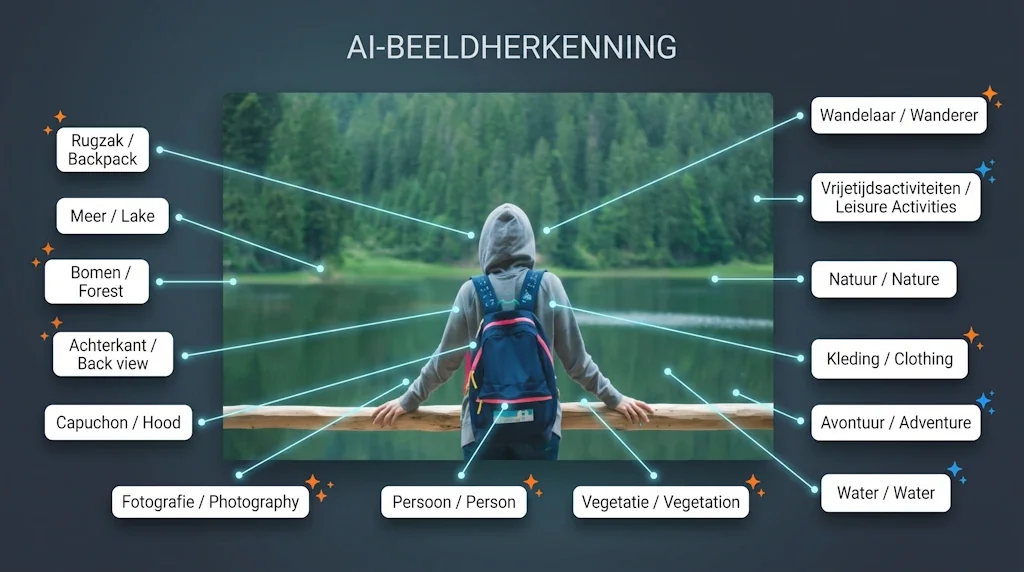
Image featuring a person from Pexels (free stock), by Atlantic Ambience
But with the advent of all that computing power, an interesting tension also arises. Think of it like a car. The dashboard says it can easily reach 220 kilometers per hour. Technically speaking, that’s fantastic. But just because the car can do it doesn’t mean, of course, that you’re allowed to do so on a Dutch highway; not to mention that, as a driver, you must also have a valid driver’s license and at least third-party liability insurance.
That's exactly how AI works in your Digital Asset Management (DAM) system.
When the AI pays a little too much attention
In their enthusiasm to automate everything, organizations sometimes forget that technology does not distinguish between what is convenient and what is legally permitted under the GDPR and the European AI Act.
Suppose you upload a beautiful photo capturing the atmosphere of an open house or a community event. You turn on AI image recognition, and within seconds, a neat list of tags appears: stage, audience, wheelchair, crutches, woman and children.
It’s a remarkable feat of technology, because the AI picks up on every detail. But from a legal standpoint, at that moment—often completely unintentionally—you’ve recorded special categories of personal data. After all, a wheelchair or crutches reveal something about a person’s medical or physical condition. And under the GDPR (Article 9 of the GDPR), the strictest rules apply to health data: you cannot simply categorize it automatically without a very specific legal basis or explicit consent.
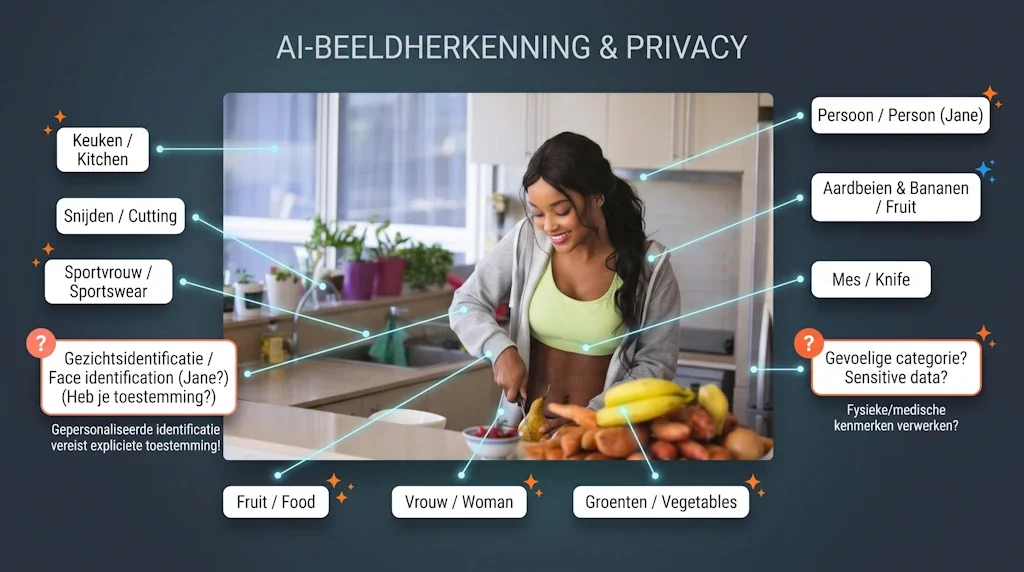
Image featuring a person from Pexels (free stock), by Nathan Cowley
Face Recognition vs. Face Identification
The same applies to faces in video footage. Colloquially, we lump everything together under the term “facial recognition,” but from a legal standpoint, there’s a world of difference between them:
Face detection (recognizing features): The AI can tell if there’s a person in the photo, if someone is smiling, and which way they’re looking. This is super handy for quickly finding the right mood shots (though, of course, the standard GDPR rules always apply when recognizable individuals are involved).
Facial recognition (biometrics): The AI links unique facial features to a specific person (“This is Jan Jansen”) in order to automatically gather all of Jan’s photos.
The latter is biometric identification. It falls under both the GDPR and the AI Act (including Article 5, Article 6, and Annex III of the AI Act), and is subject to very close scrutiny: without Jan’s prior, explicit consent, it is simply not permitted.
The technology is ready to go—what about your AI policy?
As a provider of DAM software, we at Comrads ensure that the engine under the hood runs securely, reliably, and entirely within European borders (EEA). But you, as an organization, are in the driver’s seat. AI tags are always indicative: the software does not take into account context, consent forms (quitclaims), or internal guidelines.
That certainly doesn’t mean you should hit the brakes. On the contrary: by taking a moment to review the traffic rules beforehand, you can then step on the gas with confidence. So ask yourself these three questions within your organization before you press the AI button:
Do we have a clear AI policy? Do our colleagues know which images we do and do not want to enrich automatically, and where the boundaries lie?
Is our consent management in order? When we record and tag identifiable individuals or sensitive situations, are the appropriate legal bases and quitclaims properly addressed?
Who’s keeping an eye on things (human-in-the-loop)? Think of AI tagging as a lightning-fast and enthusiastic intern: the heavy lifting is done in a fraction of a second, but a quick human check ensures everything is correct before it’s permanently saved.
AI makes working with digital assets more enjoyable, faster, and smarter than ever. And with a solid AI policy in the passenger seat, you can get the most out of this technology—safely, responsibly, and without any surprises along the way.
Wondering how you can use AI image recognition in a smart and controlled way within your DAM environment?
We'd be happy to show you how it works and help you figure out the right setup and application.
Want to know more? Here’s a summary of the key legal provisions
For those who would like to review the rules for themselves, here are the most relevant provisions from European legislation regarding AI image recognition and privacy:
From the General Data Protection Regulation (GDPR)
Article 6 of the GDPR (Lawfulness of Processing): Stipulates that you must always have a valid legal basis for processing and tagging identifiable individuals, such as consent (e.g., via a release form).
Article 9 of the GDPR (Special Categories of Personal Data): Prohibits the processing of health-related data (such as visible medical devices) and biometric identification data, unless you have explicit consent or a specific legal basis for doing so.
Article 4(14) of the GDPR (Biometric Data): Defines the difference between general physical characteristics and technical processing that can be used to uniquely identify an individual.
From the European AI Act (Regulation (EU) 2024/1689)
Article 4 of the AI Act (AI Literacy): Requires organizations to ensure that employees who work with AI tools have sufficient knowledge of how they work, as well as their opportunities and risks.
Article 5 of the AI Act (Prohibited AI Practices): Prohibits, among other things, the indiscriminate scraping of faces and biometric categorization based on sensitive characteristics.
Article 6 & Annex III of the AI Act (High-Risk AI Systems): Classifies remote biometric identification systems as high-risk, with strict requirements for human oversight (Art. 14) and user responsibility (Art. 26).
Source: Official text of the AI Act (EU)